Class 4 impact resistant shingles, and why your insurer cares
In a hail region, the roof upgrade that sometimes pays you back every year.
September 6, 2026 · 4 min read
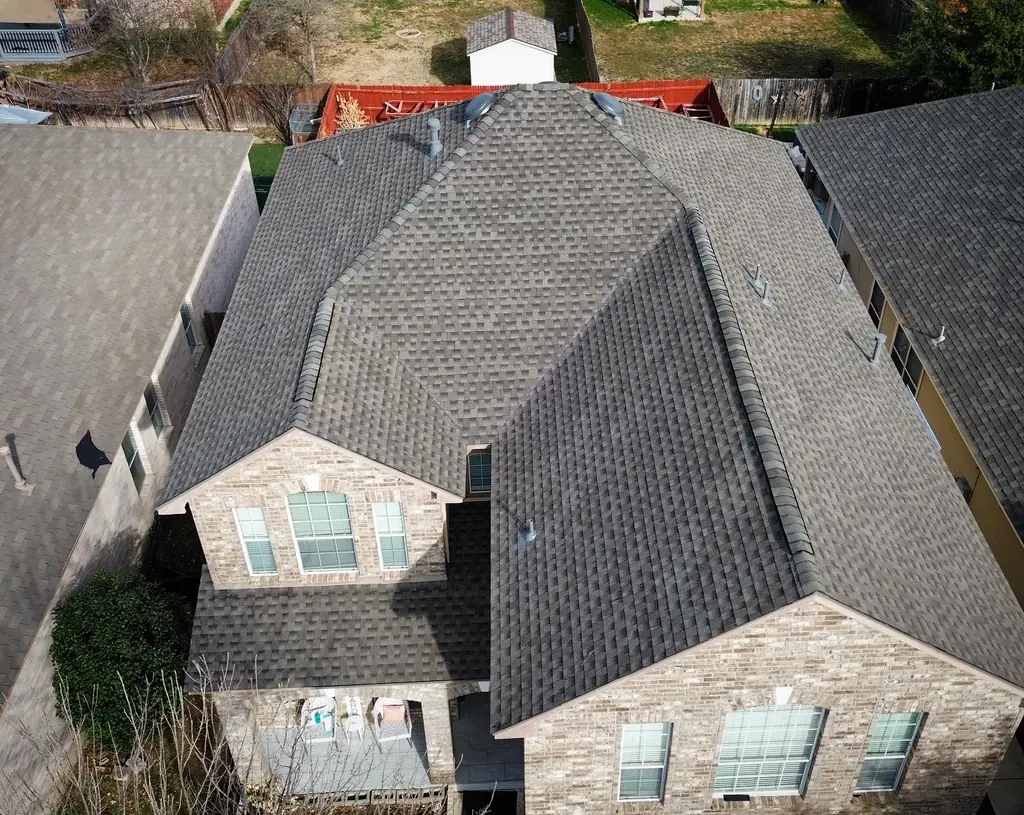
When we quote a roof replacement in San Antonio, one of the first things we raise is whether to go to Class 4 impact resistant shingles. It is not an upsell reflex. In a hail region it is often the single upgrade with the clearest case behind it, and sometimes it is the one that quietly pays for part of itself.
What the rating actually measures
Impact resistance for roofing is graded from Class 1 to Class 4, with Class 4 being the highest. The test is deliberately blunt: steel balls are dropped onto the shingle from a set height, twice on the same spot, and the shingle is then examined for cracking on the back. A Class 4 shingle is one that takes the largest test impact without splitting.
It is worth being precise about what that does and does not promise. A Class 4 shingle is much better at surviving hail without cracking. It is not indestructible, and severe enough hail can still mark or damage one. What the rating tells you is where the shingle sits on a measured scale, not that hail stops being a problem.
Why the insurance company is interested
Hail claims are expensive and, in this part of Texas, frequent. A roof that survives a hail event without needing replacement is a claim that never gets filed. That is worth real money to an insurer, and many of them price it accordingly.
This is why the upgrade can behave differently from most roofing decisions. Most upgrades cost money once. This one can cost money once and then reduce a bill that arrives every single year.
Anthony Verfaillie went this route on his replacement with us. We recommended Class 4 and walked him through the reasoning. He took it, and got a discount on his homeowner's insurance because of the upgrade.
The part we will not tell you
We will not tell you what discount you will get, because we genuinely do not know and neither does any roofer. It depends on your carrier, your policy, your location, and their current underwriting. Some insurers offer a meaningful reduction, some offer a token one, and some offer nothing at all.
Be skeptical of anyone who quotes you a specific percentage before you have spoken to your own insurer. The right sequence is straightforward: call your agent, ask what they offer for a Class 4 rated roof, and get the answer for your policy. Then you can weigh it against the cost of the upgrade with actual figures rather than a sales estimate.
When it is clearly worth it
- You are replacing the roof anyway, so you are only paying the difference rather than the whole roof
- Your carrier confirms a discount that recovers a useful share of that difference over a few years
- You have been hit by hail before, which is a reasonable predictor of being hit again
- You intend to stay in the house long enough to collect the annual saving more than once
When it is less obvious
If your insurer offers nothing for it and you are planning to sell within a couple of years, the case is weaker and rests mostly on the roof's durability rather than on the premium. That is still a real benefit. It is just a harder one to put a number against.
How to find out what you already have
Plenty of homeowners have a Class 4 roof and do not know it, which means they may be paying a premium they could have reduced years ago.
There are a few ways to find out. If you have the paperwork from the last replacement, the shingle product name is usually on it and the rating is published by the manufacturer. If the roof was done recently, the contractor may have supplied a certificate specifically for the insurer, since that is what carriers usually want to see.
If you have neither, an inspection can identify the product on the roof. That is a reasonable thing to ask for on its own, separately from any repair, and it is worth doing before your next renewal rather than after it.
It is not only about the discount
Even where a carrier offers nothing, there is a straightforward durability argument. A shingle that resists cracking under impact is a shingle that keeps its granules and its seal through a storm that would have compromised a lower rated one.
Granule loss is not cosmetic. The granules are what shield the asphalt from ultraviolet light, and a shingle that has been stripped in patches ages much faster in San Antonio sun than one that has not. Surviving hail intact is worth something regardless of what your insurer thinks about it.
Ask before the roof goes on, not after
This decision has to be made while the roof is being specified. Retrofitting it later means another replacement, which nobody wants to pay for twice.
So if a replacement is on your horizon, make the phone call to your insurance agent early, before the materials are ordered. Then tell us what they said and we will price both options honestly so you can see the difference side by side.
We install GAF and Owens Corning systems and are a GAF certified installer. Call (210) 650-2090 and we will talk it through before anybody orders anything.
Twin Hammers Roofing & Contracting, (210) 650-2090
Call (210) 650-2090